Gavin Bryars
67 pieces at nkodankoda sheet music library
over 100k editions from $14.99/month
Hassle-free. Cancel anytime.
available on

nkoda digital sheet music subscription


Editions
Annotate
Library
Perform
100k+ available Editions
More about Gavin Bryars
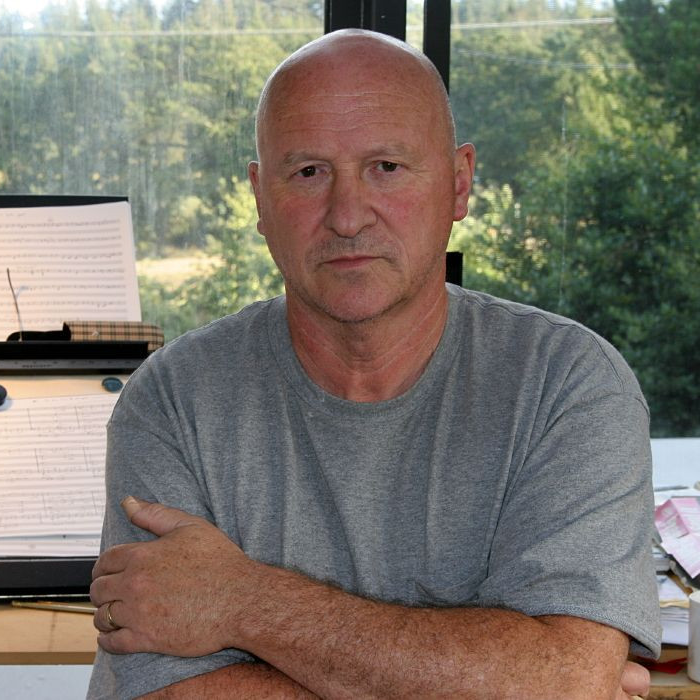
Gavin Bryars studied philosophy at Sheffield University and became a professional jazz bassist and a pioneer of free improvisation, working especially with Derek Bailey and Tony Oxley. In the late 1960s he worked with John Cage and this influenced early works such as the indeterminately scored The Sinking of the Titanic (1969) and the iconic Jesus' Blood Never Failed Me Yet (1971). From 1969 to 1978 he taught in departments of Fine Art at Portsmouth College of Artand Leicester Polytechnic, where he founded the department of music. He collaborated frequently with visual artists such as Bruce McLean, Tim Head, James Hugonin, Bill Woodrow, Will Alsop, and Juan Muñoz with whom he wrote A Man in a Room, Gambling (1992), and made installations and performance art for Tate Liverpool, Tate St. Ives, Chateau d'Oiron and other galleries. Bryars’ catalogue includes an extensive body of works for dance. Numerous choreographers have been drawn to his music, and he has collaborated on new works with the likes of Lucinda Child, Laurie Booth, William Forsyth, and David Dawson. In 1999 he wrote BIPED with Merce Cunningham, and in 2002 he worked with Carolyn Carlson on Writings on Water for the Venice Biennale, which included The North Shore (2004) for solo viola, piano and strings, In Nomine (after Purcell) (1995; 2002) for strings, and the Violin Concerto "The Bulls of Bashan" (2000) among other works. In recent years Bryars has worked with Edouard Lock on a number of projects including The Third Light (2009), Amjad (2007) which toured internationally for two years, 11th Floor (2014) for Cullberg Ballet, The Heart of August (2017) for Ballet Vlaanderen and Trick Cell Play (2019) premiered by Sao Paulo Dance Company. Most recently, Bryars Requiem (2018), for chorus and orchestra, was premiered by the Dutch National Ballet and Matthew Row with choreography by David Dawson in 2019. Bryars’ opera Medea (1984) premièred at the Opéra de Lyon and Opéra de Paris and directed by Robert Wilson). It achieved critical success and led Bryars down a new compositional path. He has since written three further operas, two with libretti by his long time collaborator Blake Morrison: Doctor Ox's Experiment (English National Opera 1998, directed by Atom Egoyan, & also at Theater Dortmund, 1999), and G (2001-2, directed by Georges Delnon), commissioned by the Staatstheater Mainz for the Gutenberg 600th anniversary. Bryars’ has written two chamber operas: The Paper Nautilus (2006) which was premiered by Theatre Cryptic, with further productions at Huddersfield Contemporary Music Festival and Long Beach Opera, and Marilyn Forever (2010-13), presented by Aventa Ensemble in autumn 2013 in Victoria, Canada, with further productions at the Adelaide Festival where he was Composer in Residence in February 2015 and at Long Beach Opera the following month. Bryars’ most recent opera The Collected Works of Billy the Kid (2018) premiered in March 2018 presented by Percussion Clavier de Lyon in production with Théâtre de la Croix-Rousse, and subsequently toured through France, Switzerland, Belgium, the Netherlands and Hungary. Bryars is particularly drawn to music for voice, resulting in a rich catalogue of choral and vocal works. Several fruitful collaborations with the Latvian Radio Choir and Estonian Male Voice Choir resulted in recordings on Bryars’ own label, GB Records. For many years he has worked with early music performers on successive Books of Madrigals: Book One (1998-2000) for The Hilliard Ensemble (texts by Blake Morrison), Book Two for (2001-02) the Trio Mediaeval Sextet (Petrarch sonnets), Book Three (2003-05) for Red Byrd (Petrarch, translated by Synge), Book Four (longer Petrarch poems), Book Five (‘I Tatti’ madrigals) in 2013, Book Six in 2015 plus two books of Irish Madrigals. He has written a large number of Laude (2008-12) for soprano Anna Maria Friman based on medieval Italian chants and set Faroese saga poetry in Tróndur í Gøtu (2008) for the Faroese bass Rúni Brattaberg following their work together on settings of old Icelandic saga poetry. His collaboration with the Royal Shakespeare Company and Opera North, Nothing Like the Sun (2007), toured the UK in 2007. Amongst his more substantial works for chorus is the recent Requiem (2018), written as part of a large-scale ballet collaboration with choreographer David Dawson for Dutch National Ballet. The Fifth Century (2014) for choir and saxophone quartet was premiered by The Crossing and Prism Saxophone Quartet and an ensuing recording with ECM went on to win a 2018 Grammy Award for Best Choral Performance. A Native Hill, Bryars’ second work for The Crossing, was premiered and recorded in 2019. New to his list of vocal works includes his arrangement Jesus' Blood Never Failed Me Yet (2018) for choir and pre-recorded tape which received its premiere by The Song Company and Antony Pitts in 2021. 2023 sees the 80th birthday year of Bryars which has seen performances by the London Philharmonic Orchestra, Estonian National Male Choir, Kammerchor Berlin, and the world premiere of Harpsichord Concerto (2023) by Mahan Esfahani and the Royal Liverpool Philharmonic Orchestra. Bryars has produced a large body of chamber music, much of it written for his own ensemble, and works for string orchestra. His catalogue includes concertos for violin, viola, cello, double bass (plus one for jazz bass), saxophone, bass oboe and piano. His work has been widely recorded on labels including ECM, Hyperion, Point, Philips, Argo, Touch, Mode, and his own GB Records. In 2020, Le Mot et le reste published Jean Louis Tallon's Gavin Bryars: En paroles, en musique. Image © Zaleski_Enteprise

Gavin Bryars sheets music on nkoda
Edition/Parts
Composer/Artist
Part
Source
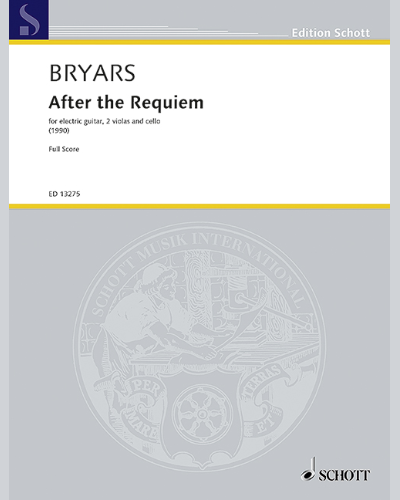
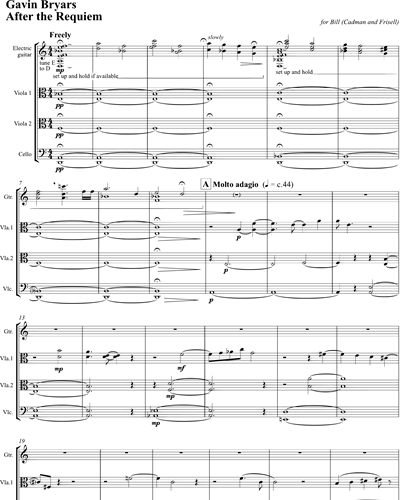
After the Requiem
Gavin Bryars
Electric Guitar, 2 Violas & Cello
Schott Music London
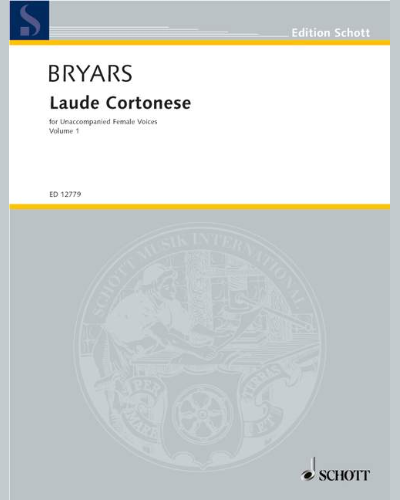
Laude Cortonese
Gavin Bryars
Female Voices
Schott Music London
Edwin Morgan Sonnets
Gavin Bryars
Male Chorus
Schott Music London
Third Book of Madrigals
Gavin Bryars
Voices & Lute
Schott Music London
Super Flumina
Gavin Bryars
Male Chorus
Schott Music London
Ramble on Cortona
Gavin Bryars
Piano
Schott Music London
Edwin Morgan Sonnets
Gavin Bryars
Mixed Chorus
Schott Music London
Tre Laude Dolçe
Gavin Bryars
Cello
Schott Music London
Credo and Benedicamus Domino
Gavin Bryars
Soprano 1 & Soprano 2 & Soprano 3
Schott Music London
Psalm 83 (84)
Gavin Bryars
Mixed Chorus
Schott Music London
Psalm 132 (133)
Gavin Bryars
Trumpet in Bb & Mixed Chorus SATB & Organ
Schott Music London
Allegrasco
Gavin Bryars
Study Score
Schott Music London
INSTITUTIONAL PARTNERS


PUBLISHERS PARTNERS


TESTIMONIALS